Monday, April 1, 2013

"Anti-theatre"

What is the point of life? Where did we come from? Is there no God?

These are some of the questions that absurd theatre tries to provoke its audiences into thinking.

     The idea of absurd theatre has its roots in philosopher Albert Camus' writings of existentialism.
This style of theatre was thought of after World War Two.  The senseless killing during the war made people recognize how precarious and illogical life can be, and playwrights wanted this reflected in their work,  in order to reflect the current reality in life, but also to inspire people to evaluate every part of their lives.

     The purpose of absurd theatre
     To represent the notion that life is absurd, and meaningless or unknown, and this in turn troubles man. Therefore, since humans have no known purpose:
- Logical arguments and dialogue becomes nonsensical and cliched as well, and are often used just to create noise onstage.
- Long silences are often used to convey meaninglessness as well.
- Plot structures aren't realistic; they focus on the idea of anything logical or illogical being able to happen to a character, instead of character development (characters often have little depth, and are stereotypes of some sort).


  •  An example of this illogical dialogue is in Harold Pinter's, The Homecoming (A man brings his wife home to his family for a visit after many years. His brothers and father lost his mother when they were younger, so they've been deprived of a mother figure for a long time. She proceeds to seduce each of her husband's brothers, and she begins filling their empty role of mother. The whole family decides, without asking her, that she will live with them and not with her husband, and will earn her board by selling her body. This is also my favourite play). In this scene, the wife and a brother fight over a glass of water:  http://youtu.be/nv4-XI1hD9o?t=2m4s.
  • Another example in the Homecoming is when one character drops dead in front of them, the family barely acknowledges the body's presence, even though it would be logical for them to express shock and grief.


    Absurd theatre usually has a cyclical plot, where the ending ends at the same place that the play begins. This is to represent the idea that change isn't reality, but only an illusion and that life is repetitious.

    Even though absurd theatre is nonsensical, it always has a theme or point that it is trying to get across.


   Absurd theatre is my absolute favourite. It's interesting to watch, and if you watch it with friends, then absurd theatre can provide a really great theatre discussion afterwards.
   The downside is if you have to analyze the text of an absurd play without having seen it, and that can be really difficult when you're trying to understand a character while they're talking about the most random things and having the weirdest arguments.


     If you want to see some absurd theatre, one of the most well-known examples, Waiting for Godot by Samuel Beckett, is performing in the Stratford festival in Ontario this year. If you like Stratford Festival on Facebook, they regularly offer discounts to different performances.

Friday, March 29, 2013

The Bard of Avon

     William Shakespeare is so widely debated. Some people hate Shakespeare, and some love his work. It's even believed by some that Shakespeare didn't write all of his plays and sonnets. I personally love reading and performing his plays. You have to admit that Shakespeare has a lot of value in and of itself.


  • One of the things that can't be denied about Shakespeare was how much he understood about humanity, and how he managed to incorporate these themes and ideas into his plays. For instance, Macbeth is one of the many plays that reveals key weaknesses of humanity, such as man's desire for power, and how man can easily be corrupted so that we act with only concern for ourselves.  


  • Shakespeare contributed so much to the written word. The plot lines of his stories are often replicated and modified in more modern literature. Shakespeare also invented new words and insults that are still used today. For instance, "your mom" jokes originate from Titus Andronicus, as well as Timon of Athens, both plays by William.

  • Shakespeare is not only invaluable to the studying of literature, but also to actors.  Shakespeare is useful in that since sometimes the meaning is difficult to comprehend at first, that actor is forced to dissect every word in order to ensure understanding. Then when it is performed, the actor is forced to put meaning into every word in the play, in order to make the sometimes hard to understand lines very clear to the audience. This is an excellent skill to have, as it aids the actor in giving more and more authentic performances.

  • Shakespeare is also great to memorize.  If I memorize lines for a modern play, I usually forget most of the lines within half a year. I still remember Shakespeare that I memorized from two years ago though.

  • One difficulty about Shakespeare is that if an actor does happen to forget their line, it's more difficult to improvise Shakespeare than to improvise more modern English. There's always many possible solutions to an actor forgetting their lines on stage though, so this is only a minor drawback.


     Most schools in North America teach Shakespeare throughout high school. The students sit through monotone re-enactments by students at the front of the class, and all students are advised to take copious notes on the plot and quotes that support different themes, and these notes are tested with quizzes and essays. I suppose this is fulfilling the purpose of curriculums to teach students to identify themes, and effectively explain their ideas, but this study of Shakespeare is certainly not inspiring any love for his work in most students.
    No play comes to life until it is read aloud by committed actors, or even better, seen visually.

       I think if students were required to put on a full length Shakespeare play and go through the process of exploring and developing characters, they would come out with a deep understanding of the play, as well as a bigger appreciation for Shakespeare's art.


     Most people that I talk to haven't seen a Shakespearean play performed. When you have a chance, go see a Shakespeare production. Hopefully you'll notice the power and magic that can harnessed onstage. 

Friday, March 22, 2013

Antagonizing Audition Anxiety

     Your heart pounds. 
Your throat squeezes your breath so hard that you can't get any air out.
     Your hands and legs start trembling so hard that on the Richter Magnitude Scale, they would probably rate a 6. 
     Your hands rain sweat.
You don't need to look in the mirror to know your cheeks are turning red.

     Most people have to endure auditions at least once in their life. Whether it's for a sports team, a play, a music competition, university, or an acting agency, it's possible to get nervous in all of those types of auditions.
     I. hate. Auditions. So far I've managed to weasel my way into four plays in the past year without having to audition...but sometime, real life is going to hit me again, and I'll have to attend another audition.  Every actor I've talked to loves performing. 100% of them also hate auditioning. Now why, would actors of all people, be afraid of an audition? We're playing characters all the time, aren't we? Aren't we used to being in front of crowds? Don't we like being in front of crowds?
      There's more pressure in an audition. In a show, unless you're doing a one person show, you often have other cast mates around to save you if you mess up. In an audition though, you've only got yourself to count on.

I think I have some of the biggest stage fright of anybody I know. It's ironic.  From performing since I was little though, I've picked up a few tips that don't necessarily have to be applied to an acting audition, but any type of audition.
  • Know your material solidly. Even whatever you have to memorize is easy technically, you still need to know it so well that you'll remember it five years later.  Recite your material backwards, and by running through the material really fast without any pauses between words.

  • Bananas and chocolate make me less nervous, as well as being well hydrated. I could be imagining it though. Who doesn't become more content while eating chocolate?
I refuse to recognize any other food group other than chocolate.
  • Prepare your outfit, any necessary materials, snacks and water, and transportation the night before your audition. I'm a lot less stressed when I'm not rushing around frazzled at the last minute trying to grab everything except the kitchen sink.

  • Don't focus on why you're at the audition, or what role you desperately want. Use the audition as an opportunity to practice in front of an audience.

  • If you're in a group audition, remember that everyone is at different stages of audition and performing experience. If you mess up, there will be other people there who sympathize, who have committed the same mistake as you.  Don't be afraid to perform.  Everyone has their own style of singing,  or acting, or expressing themselves, which is so wonderful. You can't be someone else. You've just got to work with what individual potential you've got. When you compare yourself to others, usually strangers, you're comparing a spaniel to a poodle. They both have their own positive attributes and weaknesses.  

  • Most importantly: The more you audition and perform, the less nerve wracking it becomes. There's no way around it. After a decade, I've finally gone from all my limbs shaking and my voice undulating  95.6% of the time to that only happening 7.8% of the time.

"Use what you know. Don't worry about what you don't know."
-Michael Shurtleff


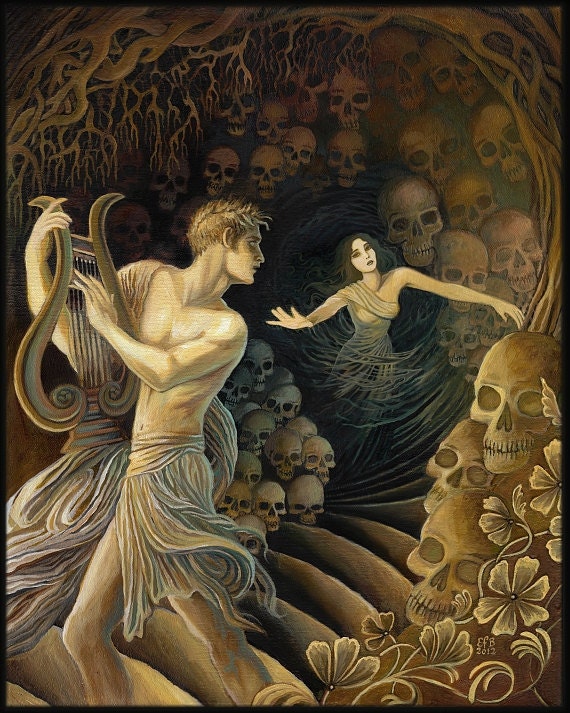
Orpheus and Eurydice - Retold


Love, Loss, Passion, and Despair.

       I'm currently part of a play called Orpheus and Eurydice, which is an ancient Greek myth.

        The plot line is that Orpheus is the musically-gifted son of Apollo. He falls in love with Eurydice, a wood nymph, and they become inseparable. Unfortunately, Eurydice gets bitten by a venomous snake and is sent to the Underworld. Orpheus loves her so much though that he goes down to find her, even though the living aren't technically allowed in the Underworld. Orpheus plays his lyre and sings, and everyone in the Underworld, including Hades and Persephone, are so moved that Hades makes a deal with him that if he walks out of the Underworld without looking at Eurydice walking behind him once, then they can return to the world of the living together. If he looks back at her before they leave, then she'll be eternally banished from him. Of course, he looks back too early (Orpheus had stepped out of the underworld, but Eurydice was still just inside the gates to the Underworld -if he'd only just waited 30 more seconds), and Eurydice is once again lost.


      The theatre company that's putting on this production decided to use a different method to tell the story onstage, and make it more abstract. Most of the play tells the story through movement and music. We've also incorporated our own experiences with love, and as the performance progresses, we switch back and forth between transitioning through all aspects of a relationship, and paralleling it with what's happening in the story. I'll have to say that I was skeptical before I joined.  It was the sort of thing that sounded like it was trying to be insightful and deep, but was really nonsense. I've since realized that this play has higher standards.


    I joined the play later than most people, so I didn't help create any of the scenes. Here are a few points that I've observed about the play though:
  • I think there's some scenes that we could cut out. I'm in the play, and even I don't understand what some small scenes are trying to portray/how they're advancing the plot. The movements in them have no value.
  • I think our play is incredibly emotionally moving.    There's this one scene where, in order to portray Orpheus as trying to overcome the obstacles that Hades sets in place between him and Eurydice, we have one person as Eurydice slowly walk all over the stage, while the cast lines up, one by one behind her, our bodies contorted in different positions connecting to each other. One person, playing Orpheus, crawls over and under us in an attempt to catch up with Eurydice, and he desperately calls out her name.  He's never able to reach her though, because the person at the end of our human "obstacle" always runs to join the other end, near Eurydice, and it seems that Orpheus is eternally having to overcome these obstacles. This scene is so creative and visually-aesthetic, and there's such a strong sense of desperation created from Orpheus, and the energy created from the rapidity in everyone except Eurydice's movements.  

If you're at all curious about this show, we'll be performing the first week of June.


Friday, March 8, 2013

Theatre culture in kw


     There are cities in Ontario that have little to no theatre companies. Kitchener-Waterloo is not one of them. We are really lucky to have a community bubbling with so much talent. Down below, I've listened as a community, our strengths, weaknesses, and how to improve.

Our strengths:

  • A plenitude of theatre companies
  • No shortage of talented actors
  • KW is incredibly full of creative, adventurous ideas
Asphalt Jungle Shorts 2012 - the audience watching a performance in Uptown Waterloo
    If you look really really carefully, there's always art happening in KW. Asphalt Jungle Shorts is an extremely creative production that performs every fall. It involves performing short plays in different outdoor and indoor locations in KW - all in one night. They were even thinking of having people stand on the rooftops in Kitchener and singing, to create the sensation of music washing over the city. Now how more creative can you get? The theatre company running that, Flush Ink Productions, also sends writers into creepy locations overnight, and they have until morning, on their own, to write a short play that is performed a week later in a performance called Unhinged.

     Our government also has paid positions where people work to strengthen the arts community in KW.


Our weaknesses:
  • Artists aren't supporting each other enough
  • We aren't making the general population take us seriously
  • Not enough rehearsal space
  • Not enough opportunities to audition for/see Shakespeare productions

    Unfortunately, the arts are still weakening from lack of funding (what's new?). Lost and Found Theatre, the only professional theatre company in the middle of KW, is severely struggling, The Clay and Glass Gallery and KW Symphony almost went bankrupt, and we've lost Theatre & Company.

     Not to mention losing the Kaufman Arts Studio. The Kaufman Arts Studio was started by Rachel Behling and her daughter, Bronte, a few years ago. They renovated an old building right by Charles Street Terminal into a cosy theatre, with a front sitting room full of bookcases and lots of tea. This small theatre provided all types of artists with an inexpensive place to gather together, and it really helped unite the whole arts community in KW. If it weren't for the Kaufman Studio, I myself probably wouldn't have found a chance to try community theatre, and theatre wouldn't have been a part of my life like it is now. This wonderful space was closed down in December 2012.
....Which brings me to my next point. There is a severe lack of rehearsal space in KW. The Conrad Centre for the Performing Arts has a rehearsal hall that costs $800 per day to rent. That's just not feasible when that alone is your revenue from ticket sales, and you're rehearsing from 2 weeks to 4 months, depending on the how.
    
    Most theatre companies anywhere either don't charge the actor, or they even pay the actor, but not in KW. Some youth theatre groups are charging kids $400 just to be in a production. This is a problem. Youth need to be able to gain the experience without having to pay an exorbitant amount of money. 


How to improve:

  • We need to increase advertising, and better promote our art to the general public
  • We need to band together as one huge, supportive arts community

     Art to many people is listening to mainstream music on the radio, or turning on the tv. We need to compete better with these forms of expression.  In order to thrive, actors and artists in KW need to band together as a collective group, in order to make resources and advice available to everyone, as well as have affordable rehearsal spaces for theatre groups to collaborate and rehearse. There needs to be a give and take with both theatre companies and the general public; if you guys support us and come see our shows, we'll generate the revenue and enthusiasm to build up our arts culture. We need to convince KW that our art is worth seeing (which it is).


          Theatre offers inexpensive entertainment. It is a great conversation piece after going out on a date or with friends.  Build your cultured taste, and go support your local theatre companies by seeing their shows.

       Don't forget, almost all of these companies and theatres have a fan page and/or a group on Facebook that will give you updates about shows coming up.  Facebook is usually more updated than their actual websites anyway.
Where to find productions to watch or audition for:
Musical Theatre:
Believe Musical Theatre Productions: http://www.believetheatre.com/
New Hamburg Community Players: http://thecommunityplayers.com/
KW Musical Productions: http://www.kwmp.ca/
Drayton Entertainment:  https://www.draytonentertainment.com/Online/default.asp
Singer's Theatre: http://thesingerstheatre.ca


If you're new to theatre, start here:
KW Youth Theatre: http://kwyouththeatre.com/
Growing in the Arts: http://www.growinginthearts.com/
JM Drama Youth Ensemble: https://www.facebook.com/pages/JM-Drama-Youth-Ensemble/142774295769093?fref=ts


If you have experience in theatre, look at these (as well as all the other companies):
Flush Ink Productions: https://www.facebook.com/groups/FlushInk/?ref=ts&fref=ts
Standard Deviation Theatre: http://standarddeviationtheatre.wordpress.com/
KW Little Theatre: http://kwlt.org/index.php
Lost and Found Theatre: https://www.facebook.com/LostAndFoundTheatre
Lightning Banjo Productions: https://www.facebook.com/lightningbanjo

Places to see theatre for an affordable price (usually $10-$15):
The MT Space: http://www.mtspace.ca/venues/courtyard-bonnie-stuart-studio-space
Conrad Centre for the Performing Arts: http://kwsymphony.ca/conradcentre/
The Registry Theatre: http://www.registrytheatre.com/

Other centers for the arts:
The Button Factory: https://www.facebook.com/pages/The-Button-Factory-Waterloo-Community-Arts-Centre/139968309387419?fref=ts
Clay and Glass Gallery: http://www.theclayandglass.ca/
Waterloo Potter's Workshop: http://www.waterloopotters.ca/
Homer Watson Gallery: http://www.homerwatson.on.ca/
Chrysalids Theatre: https://www.facebook.com/TheChrysalids
Multicultural Cinema Club: http://www.theworkingcentre.org/multicultural-cinema-club/171


and much more....I haven't even covered music schools.

Images: https://www.facebook.com/media/set/?set=oa.10150860997777231&type=1

    Thanks to Alex and Anne Marie for their insight.


Epic Theatre - Taking Down Right Wing Politicians One Play At a Time


I promise I'm not just really enthusiastic about this style of theatre; there really is a style called epic theatre.
 
"Don't be afraid of death so much as an inadequate life."

-Brecht
    Bertolt Brecht was born just over a decade before the first world war, in Germany. He was a devout Marxist, and this played a part in his desire to experiment with using theatre as a tool for displaying social and political opinions. He helped develop a style of theatre called epic theatre.
   
      The aim of epic theatre is to force the audience to reflect critically both inwards at their own lives and outwards at the play, which will have an argument over unfairness or inequality. He wanted the audience to be as detached emotionally from the characters as possible, and realize that the actors are merely manufacturing a story, because he thought emotion would override their ability to discuss rationally. Often, after the play has taken place, the actors will sit down and engage in a discussion about the play with the audience.
     He wrote his plays wanting to treat his audience intelligently, and wanting to inspire them to think, discuss, and then make change in the real world.

  Epic theatre consists of a structure of loosely connected scenes, and the characters usually represent a part of humanity. Often characters don't have actual names, but instead are called by their profession (eg Mother, Judge). Their personalities are written to be very contrasting from each other, in order to startle the audience.
     
     His plays make use of humour, dance, music, and clowning as well as straight acting to explain his political ideas in an entertaining way.


The Mother -When her son is arrested for consorting with revolutionaries, a mother in Russia takes on his role of secretly handing out leaflets that protest the low working wages and high food prices, and she becomes a figurehead for the working class, also fighting against illiteracy.

 
     Some methods that epic theatre uses to create aVerfremdungs-effekt (a distancing effect) are to:
  • Interrupt the plot with song interludes
  • Use harsh lighting, and have the tech equipment visible onstage
  • Have actors "break the fourth wall", and speak directly to the audience
  • Show signs explaining the action taking place
  • Speak the stage directions out loud
  • Do costume changes onstage
  • Use set pieces for multiple different things (eg a cardboard background used in one scene might be moved and set down as a table in another) 


     Brecht wanted his actors to remember that they were only playing a character, and often a technique called "Gestus" is used in performances, where the actor will pause for a moment in the scene, using a facial expression or position to express the emotion that the character is currently feeling at the time.


I personally find epic theatre very refreshing and thought-provoking. I highly recommend that everyone who enjoys debates and is invested in world issues and politics go to see a play by Brecht.

http://www.usq.edu.au/artsworx/schoolresources/goodwomanofszechwan/epictheatre
http://www.brainyquote.com/quotes/authors/b/bertolt_brecht.html
http://www.cs.brandeis.edu/~jamesf/goodwoman/brecht_epic_theater.html
Images: http://oughttobeclowns.blogspot.ca/2011/08/review-mother-scoop-at-more-london.html

http://www.quotecollection.com/author/bertolt-brecht/

Friday, March 1, 2013

Weird and Strange Rituals and Habits

    When I started doing theatre, I had to adapt to, and learn to accept and go along with the weird things that actors do.

Pre-show rituals:
     Numerous actors have special rituals that they will do right before a show to try to assure that it will go well. For instance, an actor on Broadway named John Lloyd hits himself with a rubber mallet and pulls on his tongue with his fingers.  Daphne Rubin Vega, an actor in the opening production of Rent lights candles before a show, and yet another actor, like many, prays and meditates.

Superstitions:
    Of course, most people laugh at the superstitions which some actors take more seriously.  One of the well known superstitions is that if "Macbeth" is said inside a theatre (unless the actual character Macbeth is being addressed), their play will be cursed. There is a chance of saving your play though if  you run immediately outside, spin around three times counterclockwise, and spit over your shoulder.
  •    One origin of this superstition is that it was thought that real witches gave the word Macbeth to Shakespeare, but then after seeing the play performed for the first time, they weren't impressed, and therefore cursed the word. 
  •       I saw the Royal Shakespeare Company put on Macbeth a few years ago, and the show was using 5 understudies because the 5 actors, including the lead for Hamlet, were all recently put in the hospital. During the show, one of the witches slipped backstage and was so injured, she couldn't come out to bow at the end.
  • Lincoln also read Macbeth the night before he was assassinated. I don't see how these superstitions could really be true, but finding that out about the Macbeth actors was eerie... In addition, if actors have been working for months on a show, then I don't they usually want to take any chances of sabotaging their hard work by saying Macbeth.
     Another common superstition is to say "break a leg" instead of "good luck" to an actor who is just about to perform, because saying good luck will actually give them bad luck. It's interesting, I've noticed, how embedded this tradition is everywhere. I've never met someone who hasn't heard this superstition. Most people follow it as well.
  
     Some more superstitions are to not wear blue or yellow, as it will cause the actor to forget their lines, mirrors should also never be used in a production, receiving flowers before the performance will cause the show to go badly, and a "ghost light" should always be left on in the middle of the stage when the theatre is not in use, otherwise a ghost will begin to haunt the theatre.

Weird Acting Exercises:
  • I went to a theatre workshop, where they made us mime being balloons that were being blown up, and then the air being released, and they made us pretend to be snakes that were being charmed by a snake charmer.  
  • So many directors of mine spend the first half hour to hour and a half of a rehearsal just to do yoga.
  • A popular exercise to develop physicality is to get us to lead with one part of our body. For example, we'll stick out our stomachs and walk around that way, to see what character we can develop from it.
  • I've had a director make us do somersaults across the floor. Then they made us roll across really limply across the floor in a crescent moon shape, like a dead body. 
  • In an audition, we were asked to walk across the room acting as different objects, including our interpretation of a taco.  
Then again, I guess theatre is strange because it attracts strange people.